Further development of failure criteria for fiber composites
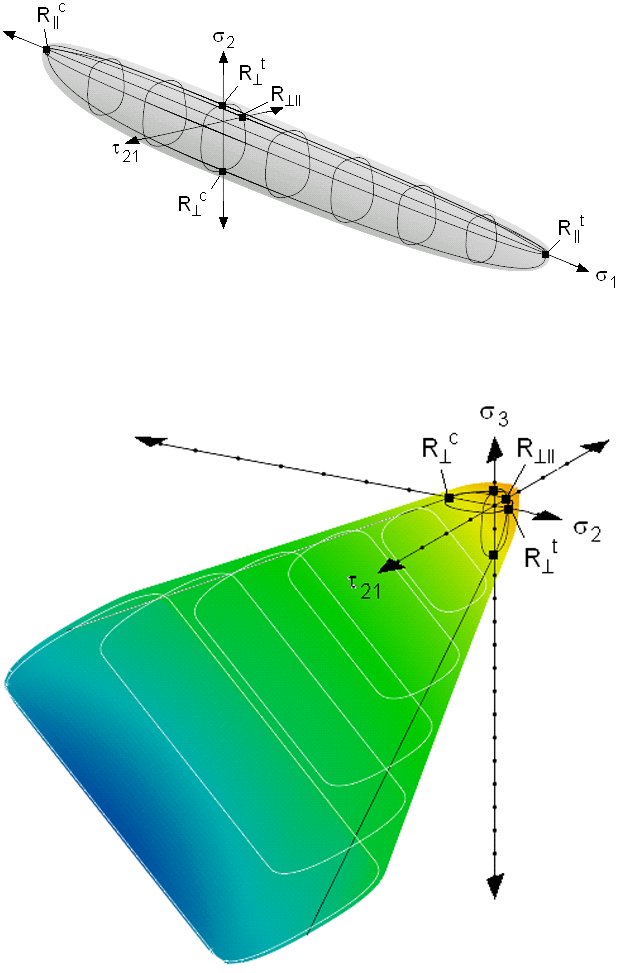
In 1998, our successful participation in the “World Wide Failure Exercise” marked the beginning of our research and development of failure criteria for fiber-reinforced composites. The calculation algorithms developed there have been continuously refined since then. For example, the original approach for transversal-isotropic materials was supplemented by an orthotropic approach with independent strengths in the thickness direction in order to more realistically map the behavior of prepregs in thick-walled structures. Virtual material characterization during testing is an almost ideal tool for identifying the failure functions of any combination of materials. Current developments focus on fabric composites under the influence of nesting and skewing.
- Collaboration on Cuntze’s failure mode concept since 1998
- Programming of the calculation algorithms for successful participation in the World Wide Failure Excercise
- Extension of the transversal-isotropic description by the orthotropic approach with independent strengths in the thickness direction
- Virtual material characterization to identify the fracture curves of any fabric composites
- Influence of nesting and skewness
Calculated service life estimation
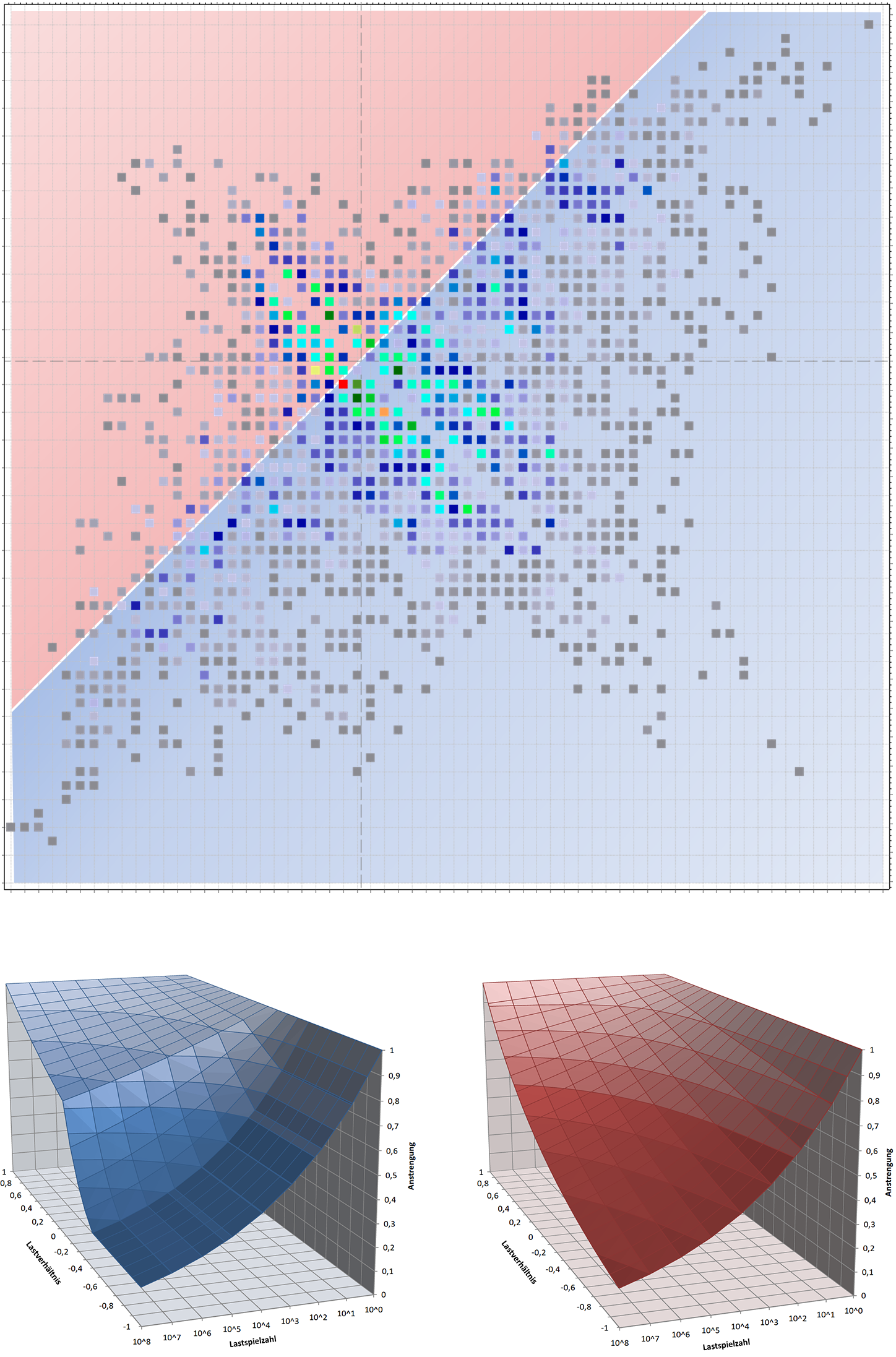
Fiber composite structures are said to have a longer service life than their lightweight competitor aluminum. In addition to the actual material advantages, however, this is often due to the oversizing. If the load collectives are known during component development, we can support you in dimensioning your components in accordance with fatigue. Our own developed model for calculating service life analysis is based on the failure mode concept according to Cuntze. Using the material stress as a damage parameter, the critical loads of the component are analyzed and the local stress conditions are determined. From a universal Wöhler surface system, synthetic Wöhler curves can then be generated for each point from static strengths in order to predict a calculated crack life.
- Service life model for composite materials
- Based on Cuntze’s fracture mode concept and static strengths
- Universal Wöhler surface system with static strengths
- Measured Wöhler curves improve accuracy
- Local tension conditions (local concept)
- Implemented in Abaqus user routine
- Can already be used in pre-development, as static strength is initially sufficient.
class-a surface quality
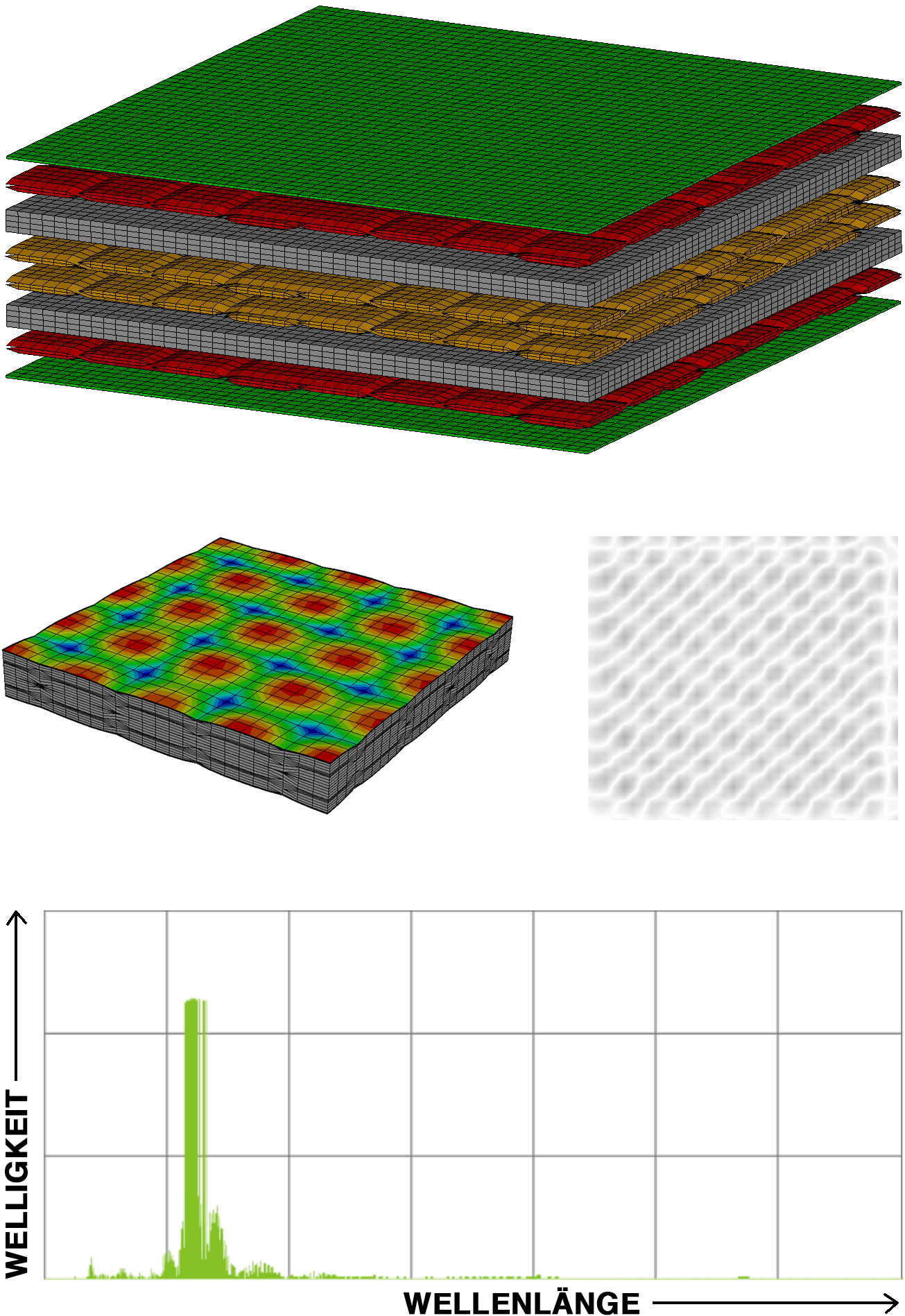
For the use of textile-reinforced thermoplastic composites in outer skin components, the requirement for a surface quality equivalent to that of metallic components represents a central challenge. As a result of the anisotropy and heterogeneity of the textile-reinforced thermoplastic composites, the reinforcement layers appear as fine ripples on the surface. The surface waviness – still acceptable in so-called visible carbon applications and sometimes desirable in order to stand out from design foils – is a significant quality defect in opaque colors. Realize Engineering has a cross-scale simulation chain for calculating the surface waviness of thermoplastic fibre composite structures for outer skin applications and – analogous to the established wave scan measurement method – can provide comparable surface characteristics that reproducibly reproduce the longwave impression. This means that your components can be objectively evaluated in the early development phase with regard to the subjective perception of the resulting surface waviness and measures for improvement can be derived.
- Based on representative volume elements
- Virtual surface characterization during the hardening and cooling process
- Determination of parameters based on the widely used wavescan method
- Display of a finely resolved ripple spectrum to identify interfering wavelengths
- Determining the cause of ripples
- Catalog of measures for their targeted avoidance
- Validation on components
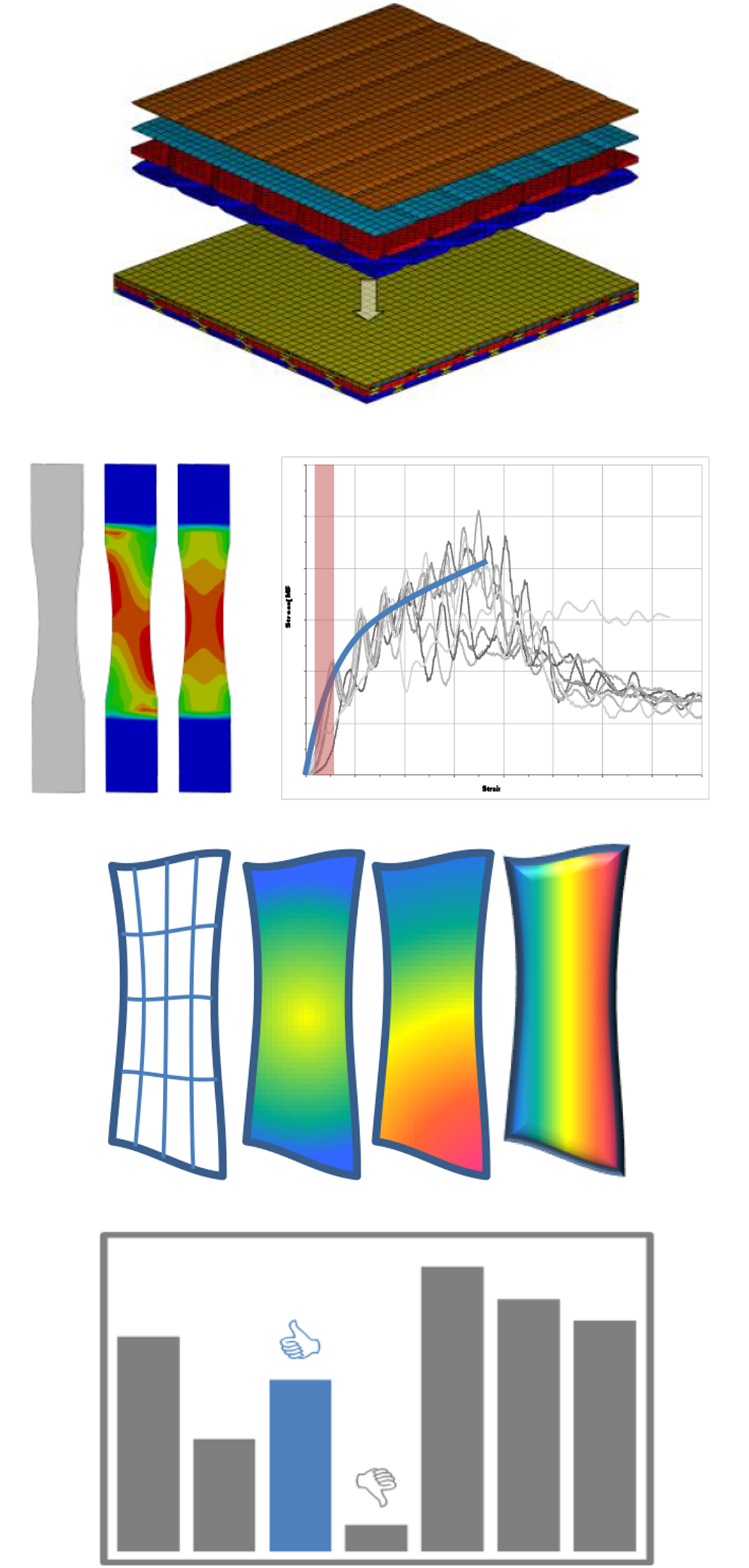
test, evaluation and analysis workflows
As a one-stop partner, we also offer support in obtaining reliable characteristic values in cooperation with renowned testing institutes. As part of a test-accompanying simulation, we develop special evaluation routines and workflows based on the characteristic functions of the material models for later use in the simulation or provide you with calibrated material cards for established and your own material models. We are happy to support you in the development of new products from the initial idea to market maturity. Sensibly reduced simulation sequences help to reduce development costs and enable you to react to market changes in good time.
- Definition of suitable tests and corresponding measuring points on the component
- Further development of test setups and test bodies
- Test-accompanying simulation
- Reduction of test programs for quality assurance
- Development of evaluation routines and workflows based on the characteristic functions of the material models for later use in the simulation
- Calibrated material cards for established and own material models
- Development of sensibly reduced simulation sequences for rapid product development
- User-defined material models with
- Definition of parameters to be evaluated and correlation with the target values together with the customer
- Advice on product development